Klamath River Closed
to Salmon
 The
bad news.....The 2017 fall salmon season is CLOSED for the year. The river
has closed to fishing as of August 15th 2017 through the end of the year. The
Trinity river is open to salmon fishing through August 31st and also closes
through the year. The
bad news.....The 2017 fall salmon season is CLOSED for the year. The river
has closed to fishing as of August 15th 2017 through the end of the year. The
Trinity river is open to salmon fishing through August 31st and also closes
through the year.
The good news is that steelhead fishing is open with the limit remaining at 2
fish per day. Anglers are seeing decent numbers of steelies in the faster slots
and riffles mainly side drifting roe.
The salmon closure is due to the past few years of drought that in turn dropped
flows and brought river temperatures up. This allowed parasites to flourish and
nearly all (90%) of the out-migrating juvenile salmon in 2015 and 2016 never
made it to sea.
We will update this page through the Fall as guides will be running some
steelhead only trips.
Major
Step Forward For Klamath River Restoration
One of the nation’s
biggest dam removal and river restoration efforts got a major boost
on Friday with Senator Ron Wyden (D-OR) announcing that he will
introduce legislation to authorize the Klamath River restoration
agreements.
Elected officials, Tribal leaders, and farming, ranching, and
conservation representatives gathered Friday to celebrate the
signing of the
Upper Klamath Basin
Comprehensive Agreement (UKBCA). The agreement resolves
water rights disputes among the Klamath Tribes and upper basin
irrigators, and permanently increases river flows, protects
riverside lands, and provides $40 million to the Klamath Tribes for
economic development.
Senator Wyden announced that he will introduce legislation that
authorizes the UKBCA, as well as the two existing Klamath settlement
agreements, the Klamath Hydropower Settlement Agreement and the
Klamath Basin Restoration Agreement. Together the three agreements
will resolve long-standing water rights disputes, increase water
supply reliability for upper basin agricultural communities, improve
river flows and water quality, restore wetlands, and allow for the
removal of PacifiCorp’s lower four Klamath River dams. The
restoration agreements are necessary to restore struggling Klamath
salmon runs.
The agreements, the first of which was finalized in 2010, are the
product of years of negotiations among more than 40 stakeholder
groups including American Rivers, with the goal of restoring the
river, reviving ailing salmon and steelhead runs, and revitalizing
fishing, tribal, and farming communities.
Removing the four dams will open access to more than 300 miles of
habitat for salmon and steelhead. When dam removal begins on the
Klamath
–scheduled for 2020 – it will be one of the nation’s largest
dam removal projects. Before the settlement agreements can be fully
implemented, Congress must pass Senator Wyden’s legislation and
appropriate funds, and California must contribute an estimated $80
million to augment the $200 million being collected from PacifiCorp
ratepayers for dam removal and river restoration. No federal funds
will be used for dam removal.
PacifiCorp’s four dams, built between 1908 and 1962, cut off
hundreds of miles of once-productive salmon spawning and rearing
habitat in the Upper Klamath, which was once the third most
productive salmon river on the West Coast. The dams also create
toxic conditions in the reservoirs that threaten the health of fish
and people.
The dams produce a nominal amount of power, which can be replaced
using renewables and efficiency measures, without contributing to
climate change. A study by the California Energy Commission and the
Department of the Interior found that removing the dams and
replacing their power would save PacifiCorp customers up to $285
million over 30 years.
Roughly
1,150 dams have been removed
nationwide and
51 dams were removed in 2013.
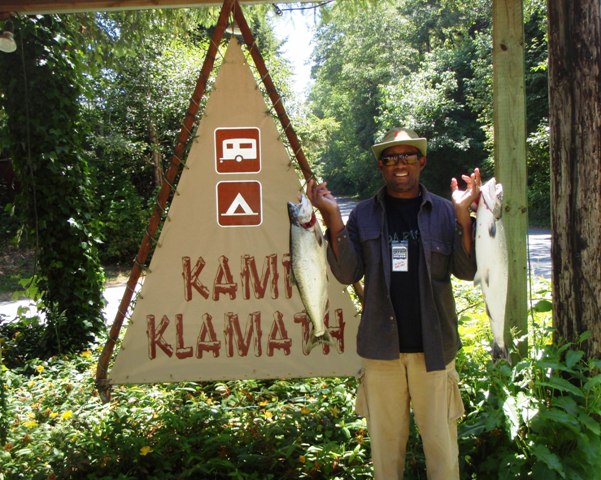
Kamp
Klamath
 Our favorite campground
Kamp Klamath "on the
quite side of the river". They offer
discounts for those
anglers looking to park
their RV for a month or
more and enjoy a few
weeks of this incredible
fishery. They have
full hookups and the
entire campground has
free Wi-Fi.
Don't miss the Saturday night salmon and chicken B-Q
with live music! Our favorite campground
Kamp Klamath "on the
quite side of the river". They offer
discounts for those
anglers looking to park
their RV for a month or
more and enjoy a few
weeks of this incredible
fishery. They have
full hookups and the
entire campground has
free Wi-Fi.
Don't miss the Saturday night salmon and chicken B-Q
with live music!
Kamp
Klamath is a secure,
quiet, forested
campground surrounded by
Redwood National Park. Great
people and a great place
to stay. 707 482-0227
Accommodations & Shops:
"Little Ray's Tackle" in
Klamath Glen. For all
your tackle needs stop
by Little Rays. This is
a must stop for anglers
new to the river. The
crew behind the counter
will be more than happy
to answer all your
questions and point you
in the right direction.
Located just past the
Steelhead Lodge. 707
482-7725
In Seiad Valley sits
the
Klamath
River Side Park
a quiet little RV park
right on the banks of
the Klamath for anglers
looking for a quieter
stretch of the river
away from the crowds.
River Levels:


For river status (low flow
closure) updates from Fish
and Game please call
+1.707.442.4502 for the
North coast and
+1.707.944.5533 for Central
coast streams. Be sure to
check out the
California Fish and Game
regulations
before you go. Regulations
vary on every river and you
need to pay attention to
bait and hook restrictions.
Due to winter closures on
HWYs 5, 101 & 299 we
recommend you check
Caltrans road conditions
as well.
Caught
Fish?
Looking for timely
informative updates? Check
out a FREE trial to the
Northern California Ho tsheet,
California's fastest growing
fishing newsletter. The
Hotsheet
is emailed three to four
evenings per week direct to
your desktop. No hunting the
web for information or
waiting on an outdated
magazine to arrive in the
mail. These in-depth reports
keep you on top of what is
happening TODAY so you can
catch more fish tomorrow!
Just $3.50 per month when
you subscribe for one year.
You can receive a free
week's trial copy by
e-mailing a request to
hurleyjacks@aol.com tsheet,
California's fastest growing
fishing newsletter. The
Hotsheet
is emailed three to four
evenings per week direct to
your desktop. No hunting the
web for information or
waiting on an outdated
magazine to arrive in the
mail. These in-depth reports
keep you on top of what is
happening TODAY so you can
catch more fish tomorrow!
Just $3.50 per month when
you subscribe for one year.
You can receive a free
week's trial copy by
e-mailing a request to
hurleyjacks@aol.com
|